A smart model doesn’t make up for bad context.
Anthropic recently published a Postmortem that showed how a bug in Context management dramatically blew up the costs of Opus 4.7 and drained users’ Token limit super fast (link).
To be clear, Opus 4.7 is an amazing model with insane research abilities (link to the benchmarks). The problem wasn’t the model - it was the amount of unnecessary Context it got.
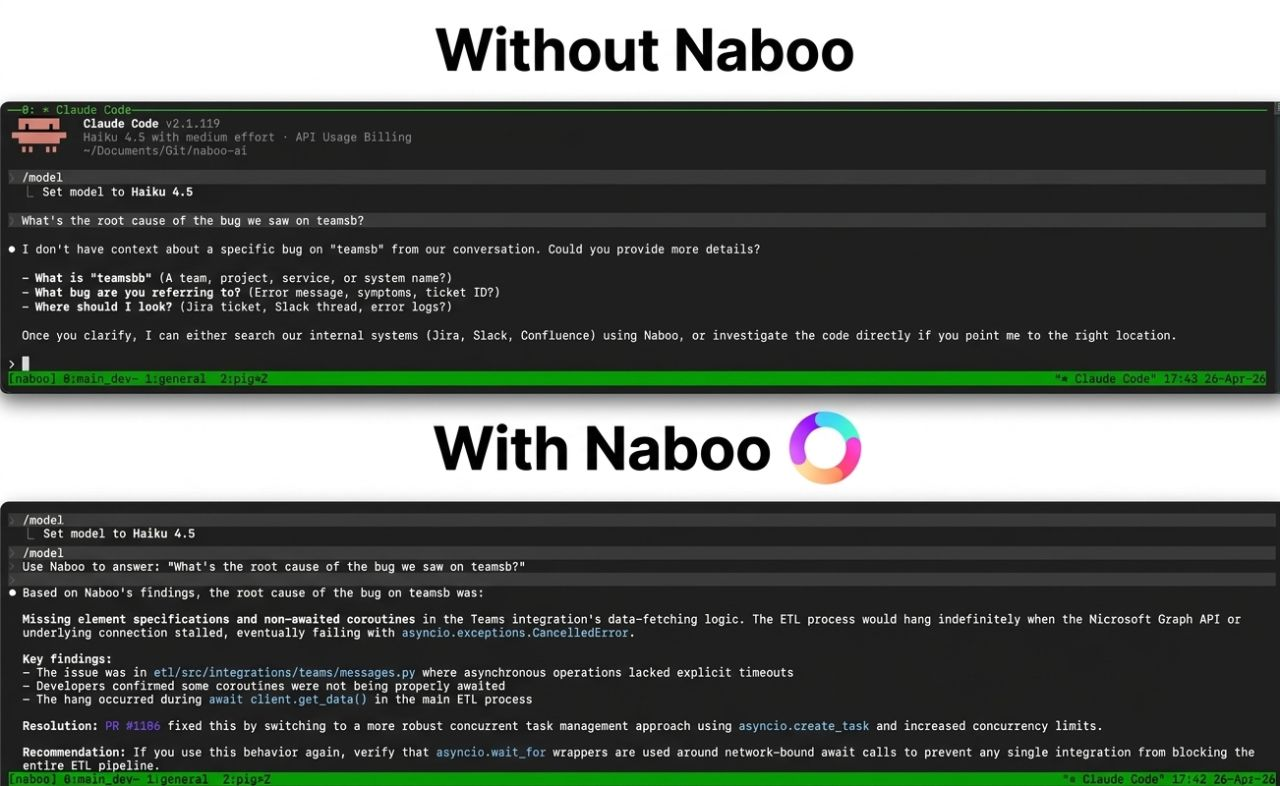
At Naboo we ran an experiment to show that with the right context, you can get the results of an expensive model - from a lean and cheap one. We took Haiku 4.5 and asked it a vague question from our day-to-day development:
What’s the root cause of the bug we saw on teamsb?
(without explaining what teamsb is - it’s our Teams integration - or where to look).
In the image you can see two runs of Claude Code on Haiku 4.5:
- Without Naboo: the model gets lost and asks for clarifications.
- With Naboo’s context: the model pulls the exact solution in seconds. And with a tiny amount of tokens.
It’s important to say that we tailor the context using thousands of organizational variables: What did the user work on? Repos related to the user? Basically a whole smart organizational knowledge graph that understands the user’s Intent.
- Nave