People ask me where to start with AI R&D. This is the answer I keep giving.
How I actually learn something
This is what I do. Steal it.
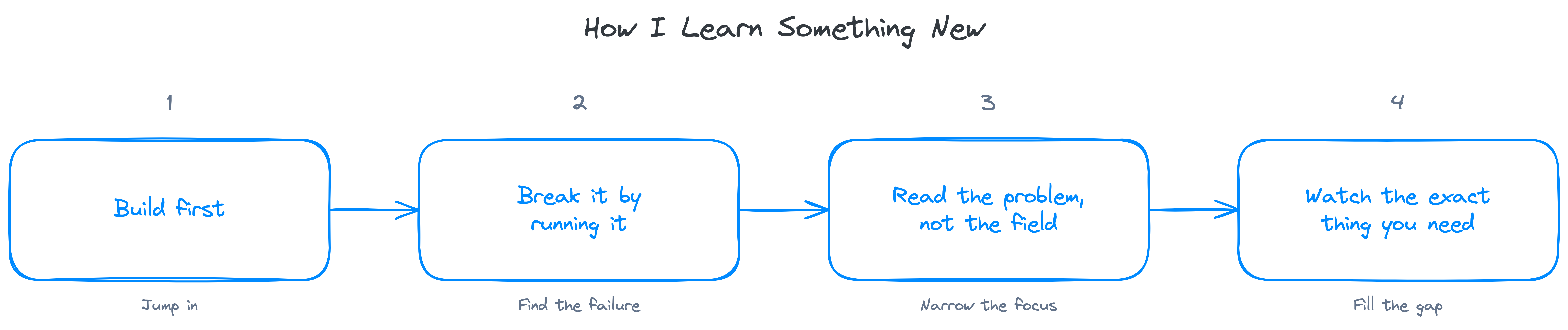
Build first. Jump straight into a real project, the thing you actually want to exist. Not a tutorial project.
Break it by running it. Run it before you understand it, and let it fail. The failure tells you which part you do not understand yet. That is the part to go read about.
Read the problem, not the field. Articles that touch the exact thing you are stuck on. Not a survey of the landscape.
Watch the exact thing you need. Fifteen minutes of someone doing the one thing. Not a four hour tutorial where the part you need shows up at minute 190.
The map
Everything worth learning here, and where I am on writing it up. A linked title means the article exists. The rest is the territory, in the order it tends to matter.
Foundations
- Models - small vs big, effort, and when to reach for which. Most of what people send to a frontier model is classification, not reasoning.
- Context engineering - the right context beats a bigger model. The thread running through everything below, and the thing people skip.
Building agents
- Harness - the software your model runs inside. Five parts, a prompt for each.
- Skills - packaged instructions an agent loads only when a task needs them. Claude Code docs.
- Plugins - bundles of skills, commands, and hooks you install into an agent. Claude Code docs.
- MCP - a standard interface so any model can call your tools without a bespoke integration each time.
- Multi-agent - running sub-agents in parallel, and the harder question of when that actually helps instead of just costing more.
- Guardrails and human in the loop - approval gates and scope checks before an agent does something with real effects.
Retrieval and knowledge
- Searching methods - lexical, semantic, structured, and graph. Which one fits which question.
- WikiLLM - an LLM maintained wiki that compounds knowledge, instead of RAG re-deriving it on every query. Karpathy’s note. Wikis are not for humans anymore.
Your codebase
- AI Native Codebase - a repo an agent walks into cold and is useful in on the first try.
- Self-reflection and self-improvement - suffer once, not twice. The lesson from a mistake goes back into the repo so the next session does not repeat it.
Knowing it works
- Evals - how do you actually know it works? LLM as judge, regression tests, and catching the change that quietly made it worse.
Plumbing
- SSE / Streaming - the server-sent events under most chat UIs. One direction, server to client.
- Transport - stdio for a tool running next to the model, HTTP for one running as its own service. Pick by where the thing lives.
Tooling
- Claude Code - the power-user tricks that make the agent actually fast.
Start with these three
The three that are written, in the order that costs you the least backtracking. Each gives you something to run, not theory to read.
- Why: the harness is the part of an agent you actually own. Skip it and you are configuring a framework you cannot debug.
- You will earn: your own harness, and the five parts every agent is made of.
- Inside: the five parts, a prompt for each, and how to build on top of pi.
How to build the right searching tools?
- Why: retrieval decides what the model sees. Everyone reaches for embeddings first, and it is usually the wrong call.
- You will earn: knowing which of four search methods fits which question.
- Inside: four methods, one incident, each blind to what the next one catches.
How can I have an AI Native Codebase?
- Why: an agent opening your repo cold makes the same mistakes every session.
- You will earn: a repo an agent walks into and is useful in on the first try.
- Inside: orientation, capability, enforcement, and self-improvement.
Who to follow
The people I actually learn from.
- earendil - clear writing on harnesses and agents
- Theo (t3dot) - builds things on camera, no filler
- AI Engineer - the conference talks worth your time
- Matt Pocock - TypeScript and AI, sharp and short